EU to Indian shoe size, and what to do when you land between two
Posted by Fanture, Surat, Gujarat. Who that is

Indian sizing follows UK sizing, so IND-UK 8 is EU 42. That one line answers most of the question, and the whole chart is a few paragraphs down.
What it does not answer is the harder case. You measure your foot, the number lands between two rows, and you have to pick one. Go up. The reason is in how the footbed is moulded rather than in anything we tested, and it is worth understanding before you order, because we do not do size swaps.
That last part is why this exists. Our returns are defect-only, a manufacturing defect, damage on arrival, or the wrong item, reported within 7 days. A size you do not get on with is none of those, so it stays with you. Five minutes with a sheet of paper is a better use of your time than a lot of the shopping around it.
The chart: EU, IND-UK, US and centimetres
The CM figure is foot length, not shoe length. When the columns disagree with each other, that is the one to trust, because it is the only one measured off a foot instead of converted off a label.
- EU 38, IND-UK 5, US M 6 / US W 7.5, 24.0 cm (9.4 in)
- EU 39, IND-UK 6, US M 7 / US W 8.5, 24.5 cm (9.6 in)
- EU 40, IND-UK 6.5, US M 7.5 / US W 9, 25.0 cm (9.8 in)
- EU 41, IND-UK 7, US M 8 / US W 9.5, 25.5 cm (10.0 in)
- EU 42, IND-UK 8, US M 9 / US W 10.5, 26.5 cm (10.4 in)
- EU 43, IND-UK 8.5, US M 9.5 / US W 11, 27.0 cm (10.6 in)
- EU 44, IND-UK 9.5, US M 10.5 / US W 12, 28.0 cm (11.0 in)
- EU 45, IND-UK 10, US M 11 / US W 12.5, 28.5 cm (11.2 in)
- EU 46, IND-UK 11, US M 12 / US W 13.5, 29.5 cm (11.6 in)
The same nine rows sit on every product page, next to a converter that takes centimetres, inches, US or IND-UK and gives you the rest. One aside while you are among the numbers: the only pair we have ever put on a scale is an EU 42, at roughly 120 g a shoe, which is why that is the only size we ever quote a weight for.
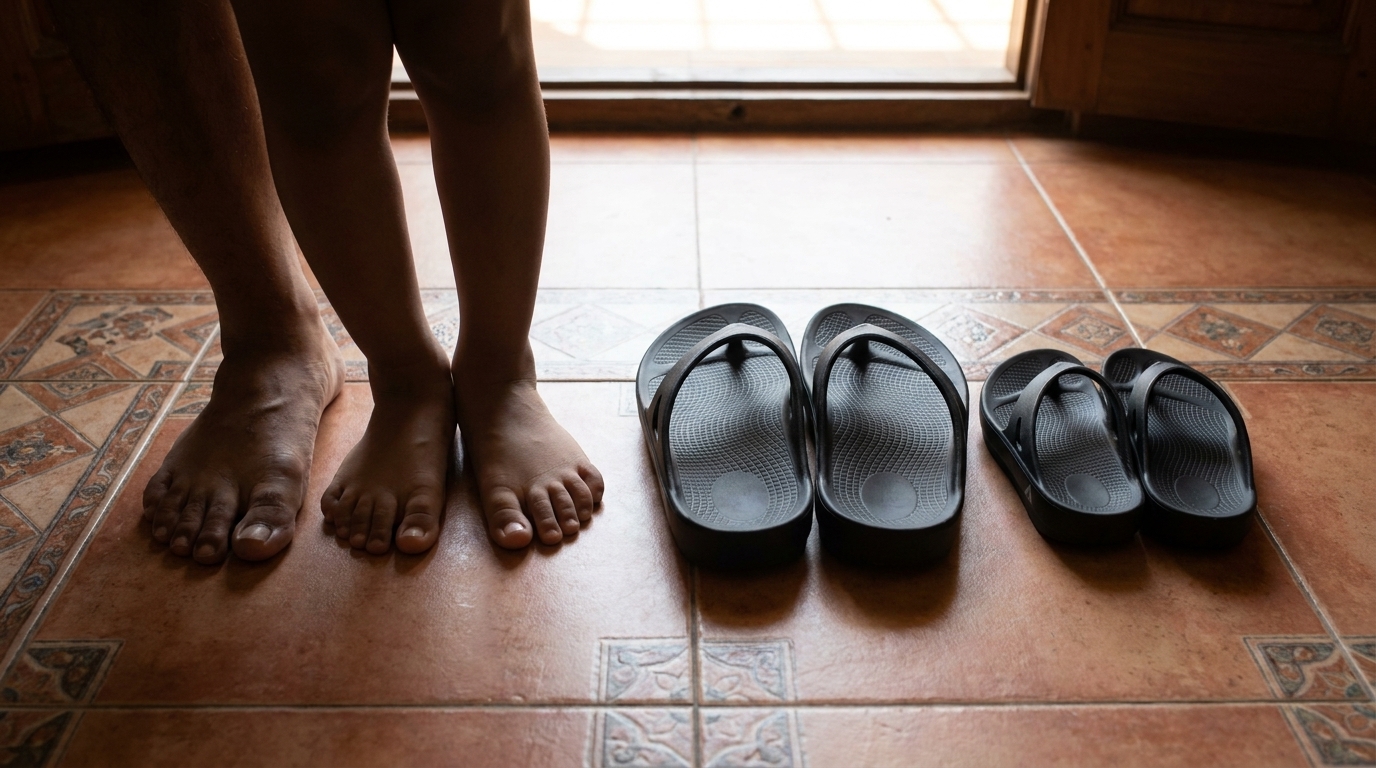
Nine whole sizes, no halves
Everything is moulded in whole EU sizes, so there are no half sizes either. The halves you can see in the IND-UK and US columns, 6.5, 8.5, 9.5, are what happens when a whole EU mould is converted onto a scale that does not line up with it. They are conversions, not extra sizes we make. For the same reason IND-UK 9 has no row of its own: round it up, to EU 44.
If your measurement falls between two rows, the section below is written for you.
How to measure a foot with a sheet of paper and a wall
- Put a sheet of paper on a hard floor with one short edge pressed flat against a wall. Carpet reads long, so use tile, wood or stone.
- Stand on the paper barefoot with your heel against the wall. These are worn without socks, so measure the way you will wear them.
- Put your weight on that foot. A foot carrying you is longer than a foot you are holding in the air, and you will be standing in these.
- Get someone to mark the paper at the end of your longest toe. On plenty of feet that is the second toe, not the big one.
- Measure from the wall edge of the paper to the mark, in centimetres.
- Now do the other foot. Most people have one that is a little bigger. The bigger one is the one that decides.
Do this in the evening rather than first thing. Feet swell over a day spent upright, and the pair you are buying is for hour nine of that day, not hour one.
Then find your number in the CM column. If you measure 26.5, you are an EU 42 and you are finished. If you measure something the chart does not contain, keep reading.
Between two rows, go up
Say you measure 26.0 cm. That is past the EU 41 row at 25.5 and short of the EU 42 row at 26.5. Take the 42.
The reasoning is geometric, not experimental. The arch contour and the heel cup are moulded into the footbed at fixed points, and those points do not move to accommodate you. On a pair that is short for your foot, your arch sits forward of the contour and your heel rides up on the lip of the cup instead of settling down inside it. The shape is still in the sole. Your foot is simply no longer on it, and a contoured footbed you are not standing on is a flat one.
Go the other way and you lose a bit of slack in front of your toes, which you will notice and then stop noticing.
Slightly too big costs you a little slack. Slightly too small costs you the contour you paid for.
We are reasoning from how the sole is made here, not from a measurement, there is no lab behind this page. If you want the longer version of what that footbed and that foam are doing, it is on the technology page.
Wide feet get the next size up too
There is no fabric anywhere in this shoe. The upper is moulded foam, the same material as the sole under it. It will not stretch to meet a wide foot and there is no breaking-in week in which it might soften and give.
So the extra length in the next size up is the only extra room available to you. If your feet are wide, take it, and take it whether or not your measurement was borderline.
What unisex means if you have always shopped a women's chart
Every style here is unisex. There is one mould per size and the same pair goes to everyone, which is why both US columns sit on the chart rather than one.
If you are used to a US women's chart, read straight across: US W 9 is EU 40 and IND-UK 6.5. Nothing is being translated twice, and there is no men's number underneath that you are supposed to work back from. The EU number and the centimetre number are the neutral ones. The two US columns are there so that whichever number you already know can get you to them.
Does a toe post fit differently from a closed clog?
The size number does not change between the five styles, because the footbed, the foam and the outsole are identical in all five. Only the upper differs, which is also why they all cost the same. What changes between shapes is where a bit of extra length shows itself.
On the toe-post styles, Ultimate and Ardour, and on the two slides, Aroma Pro and Adventure, your foot is open at the heel and along both sides. Length you do not need shows up as visible footbed in front of your toes and behind your heel. You can see it, and some people dislike seeing it more than they dislike the fit.
On the Halo Clog the toe is closed, so that same length is enclosed. It reads as air in front of your toes rather than as sole you can look at.
The toe post itself is a different question from size, and worth separating. It sits between your first and second toe, and either you get on with that or you never have. No size fixes a toe post you dislike; a slide or the clog does. The fit quiz asks about shape before it asks about anything else, and takes four questions.
Why we labour a size chart this hard
Returns here cover a defect, damage that arrived with the box, or the wrong item in it, within 7 days, and an accepted claim gets a free reverse pickup. There is no change-of-mind window and there are no size exchanges. The policy is written out in full, and we would rather you read it before you order than after the courier has gone.
That is narrower than what a lot of shops offer, and we are not going to dress it up as a feature. What it does mean is that the five minutes with the paper are the highest-value five minutes in this purchase. If you are still unsure at the end of them, message us with your foot length in centimetres and the size you wear in another brand, before you pay rather than after. A person answers that, and it costs both of us far less than a pair that does not fit.
When the number is settled, the range is here: five shapes, sixteen colourways, one price.
The short answers
What is IND-UK 8 in EU?
EU 42. Indian sizing runs on the UK scale, so the IND-UK column and a UK column are the same column. That row is also US M 9, US W 10.5, and 26.5 cm of foot.
Do you make half sizes?
No. Every size is moulded whole, EU 38 to 46. The half numbers in the IND-UK and US columns are conversions of whole EU moulds rather than sizes you can order.
I measured 24.5 cm. What do I order?
EU 39, which is IND-UK 6. If you measure 24.7 cm, take EU 40, IND-UK 6.5. Same rule as everywhere else on this page: between two rows, go up. A footbed that falls short of your foot puts the arch contour and the heel cup behind where your foot actually needs them.
Can I exchange it if the size turns out wrong?
No. Size swaps are not covered, and neither is a change of mind. That is exactly why the chart, the converter on every product page and the fit quiz get more room on this site than they get in most shops.
I have never got on with a toe post. What should I take?
A slide or the clog. The Aroma Pro and the Adventure run one strap across the foot with nothing between the toes; the Halo closes over them entirely. All three sit on the same footbed as the two flip flops, at the same price, so skipping the toe post costs you nothing but the shape.
The foam is heat-sensitive and that is on every product page above the button. Everything else we can't do is in the guides.