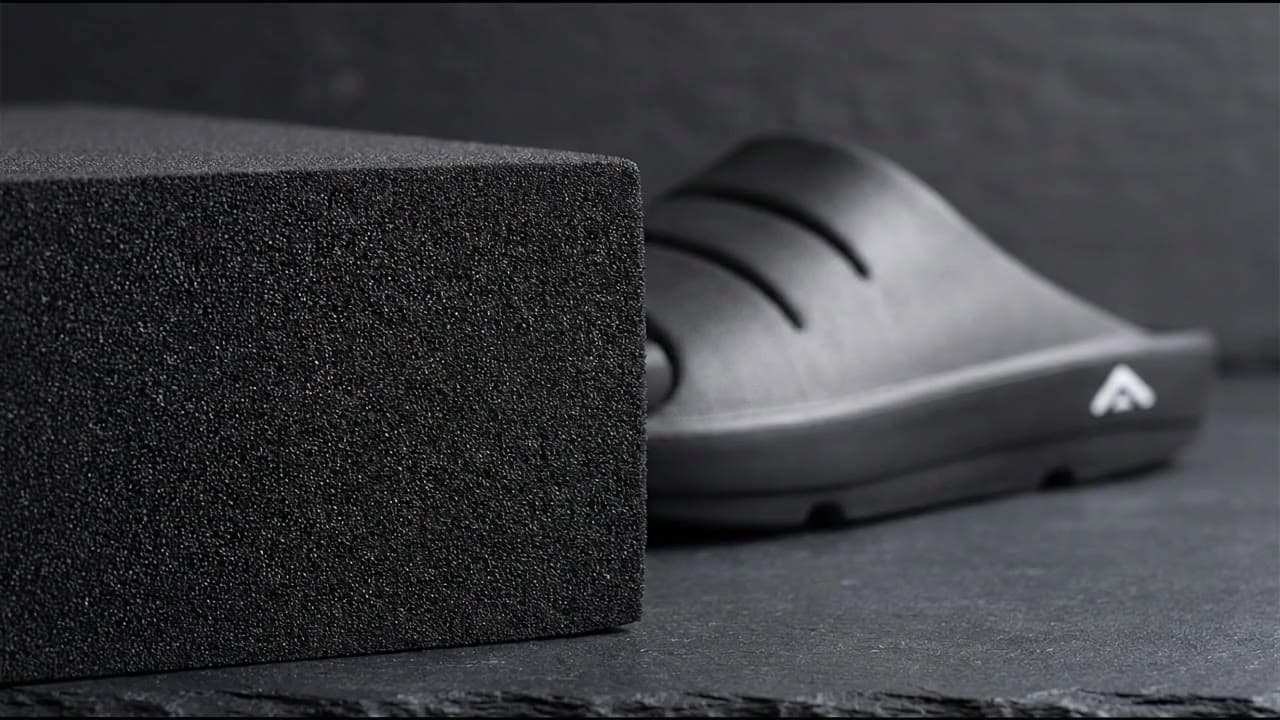
What this foam can't do
Keep them out of direct sun and away from heat. CloudFoam™ can shrink or warp if it is left on a hot surface, in a parked car or near a heater, or washed in hot water. Rinse in cool water and dry in the shade. Heat damage is not covered by returns.
We chose this foam knowing that, and we would choose it again. The softness is the point: a foam that gives way under a heel at the end of a long shift is a foam that also gives way in a car parked in the sun. A compound hard enough to survive the dashboard would do nothing for the floor you actually stand on. So we optimised for the floor, and we put the consequence at the top of the page instead of in a warranty clause.
- Drying on a terrace, a balcony or a sunny windowsill
- The surface of the foam shrinks faster than the core, so the sole curls and the footbed loses the contour it was moulded with.
- Instead
Dry them indoors, out of direct light. They are quick-drying, sun buys you nothing. - A parked car: dashboard, parcel shelf, boot
- A closed cabin in the sun gets far hotter than the air outside, and the foam softens and takes the shape of whatever it is pressed against.
- Instead
Keep the pair in the footwell, or carry it inside with you. - Hot water, a hot rinse, a hot wash cycle, a bucket off the geyser
- The pair is waterproof, so it looks washable at any temperature. It is the temperature that does the damage, not the water.
- Instead
Rinse cold or lukewarm, with a little mild soap if it needs it. - A room heater, a radiator, a tumble dryer, a hair dryer
- The same effect as the sun, only closer and faster, and applied to one side of the shoe at a time.
- Instead
Air only. Nothing that blows or radiates heat, at any setting.
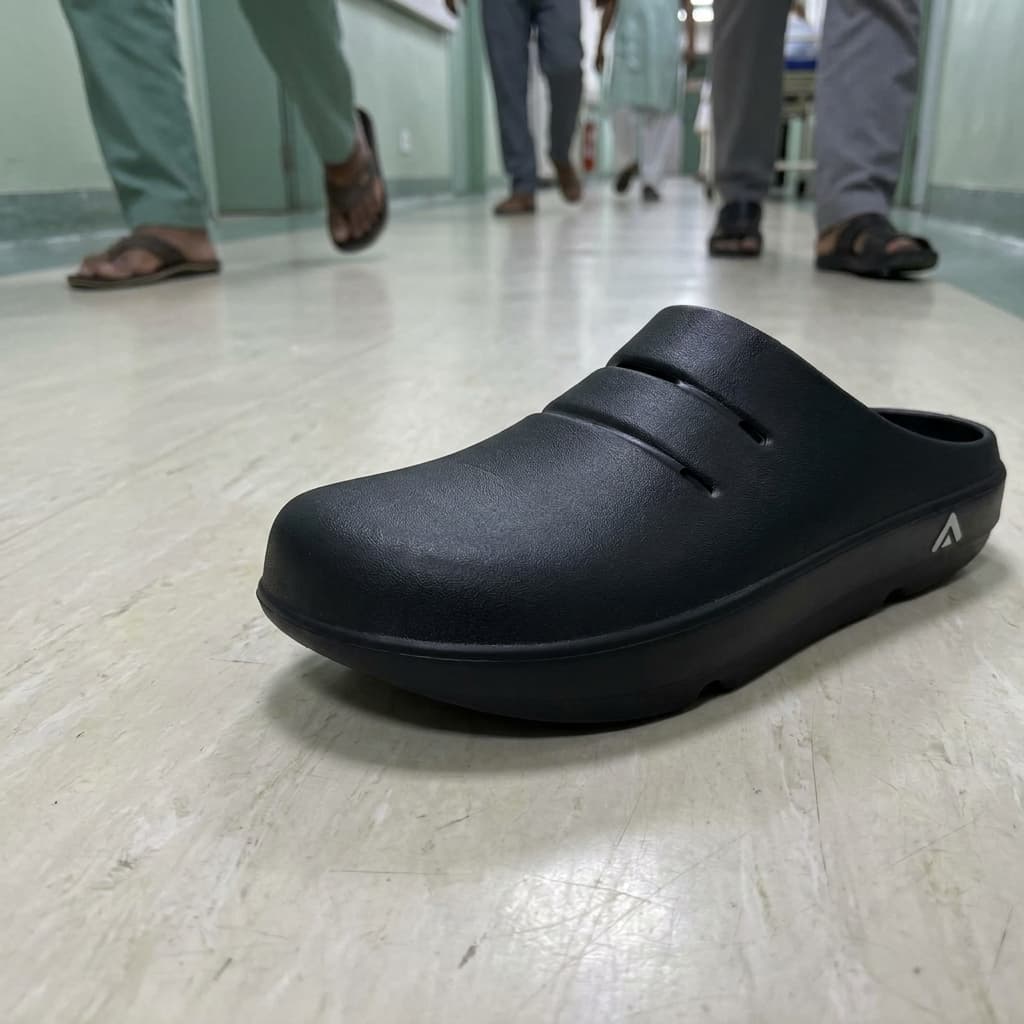
The holes through the upper and the channels through the sole are the same idea in two places: give the water somewhere to go.
Four parts, and what each one is for
The footbed is a shape, not a thickness
Put a flat sole under a foot and the arch spans a gap. Whatever the arch is not carrying lands on the heel and the ball of the foot, because those are the parts still touching the sole.
A contoured footbed fills that gap. The middle of the foot makes contact, so the same body weight is spread across more of the sole, and pressure is force divided by area, so widening the area under load lowers the pressure at the two spots that were carrying it. That is the whole of what ArcFit™ is: a redistribution, not a cushion. It is also why the shape of a footbed matters more than how thick it is.
Fused granules instead of a slab
The usual way to make a soft sole is a sheet of EVA, cut and pressed. That is one continuous material, and continuous material takes a set: hold it compressed long enough and it stays compressed. It is why an EVA slide feels good for a while and flat after that.
CloudFoam™ is made the other way round. The foam is expanded into granules first and then fused into the shape of the sole, so instead of one block you are standing on thousands of small ones. Each granule behaves like its own spring, and the boundaries between them give the material somewhere to deform into and a route back out. It packs down more slowly than a slab.
How many months yours will last, we can't tell you. We haven't measured it, and anyone quoting you a figure for it probably hasn't either. The other thing the granules do is texture, the surface isn't smooth, and you feel it move under the foot as you walk.
The heel cup is what keeps the contour under your arch
A shaped footbed only does anything if the foot is sitting where the shape is. The deep cup around the heel is the part that keeps it there.
Without it the heel drifts a few millimetres on every step and the arch contour ends up under the wrong part of the foot, which is the same as not having a contour at all. It is the least visible part of the shoe and the one that stops the rest of it from being decorative.
The outsole is cut to let water leave
The tread is a geometric non-slip pattern with channels cut through it, so water runs off the sole instead of sitting in a film between the sole and a wet floor, that film is what makes a wet floor slippery. Where a style has a closed upper, it is drilled through for the same reason: a spill on a kitchen line drains instead of pooling around the foot.
The whole shoe is one waterproof piece, no fabric lining, no insole glued in, nothing layered that can come apart. Rinse it under a tap, shake it, put it back on. That construction is also why a pair is light: roughly 120 g per shoe at EU 42. That is the EU 42 figure specifically. Bigger sizes use more foam and we have not weighed every one of them, so we quote the size we know.
Where the numbers would go
There are no percentages on this page. There used to be three, about pressure under a standing foot, pressure while walking, and how much impact the foam absorbs. None of us could tell you who took those readings, on what instrument, on what date or on how many pairs, so they came off the site.
The code that would print them is still here and still empty. The day a figure exists with a method, a date and a sample size attached to it, this space fills in on its own. Until then, an explanation you can check against your own feet is the honest version of a number.
How do you wash them?
There is no lining and no removable insole, so washing the shoe is washing all of it. The only rule that matters is the one above: cold or lukewarm, never hot.
- 01Rinse under a cold or lukewarm tap. A little mild soap if they have had a rough week.
- 02A soft brush through the tread channels, that is where a wet floor grip actually lives, and it is the first thing to clog.
- 03Shake the water out through the drainage holes and stand them somewhere indoors with air moving.
- 04No machine, no dryer, no heater, no sun. If you are tempted to speed it up, that is the moment the pair gets damaged.