Why standing all day at work is harder on your feet than walking
Posted by Fanture, Surat, Gujarat. Who that is
If you stand still for a living and your feet are finished by hour six, that is the job doing it. Walking unloads a foot every step. Standing on a hard floor unloads nothing: the heel and the ball of each foot hold your body weight for the length of the shift, and if the sole underneath is flat, the arch between those two points is spanning air the entire time. Changing what is under your feet can move where that load sits. It cannot hand you a chair.
Why does standing still hurt more than walking?
A step has two halves. The foot takes the load, then it leaves the ground and carries nothing at all while the other one works. A long walk is thousands of small breaks, handed out one after another, alternating.
Standing deletes the break. The posture holds, the load stays in the same places, and the floor does not move. Someone who covers two hundred metres behind a till can finish the day worse off than someone who walked five kilometres, and there is nothing strange about that. It is the difference between load that cycles and load that just sits there.
The floor makes it sharper. Concrete and tile return nothing, so the only thing between your body weight and a surface that will not yield is whatever you put on your feet that morning.
The heel and the ball do the whole day
Pressure is force divided by area. Your body weight is what it is, and standing at a counter you cannot change it. The only variable left is how much of your foot is actually touching something.
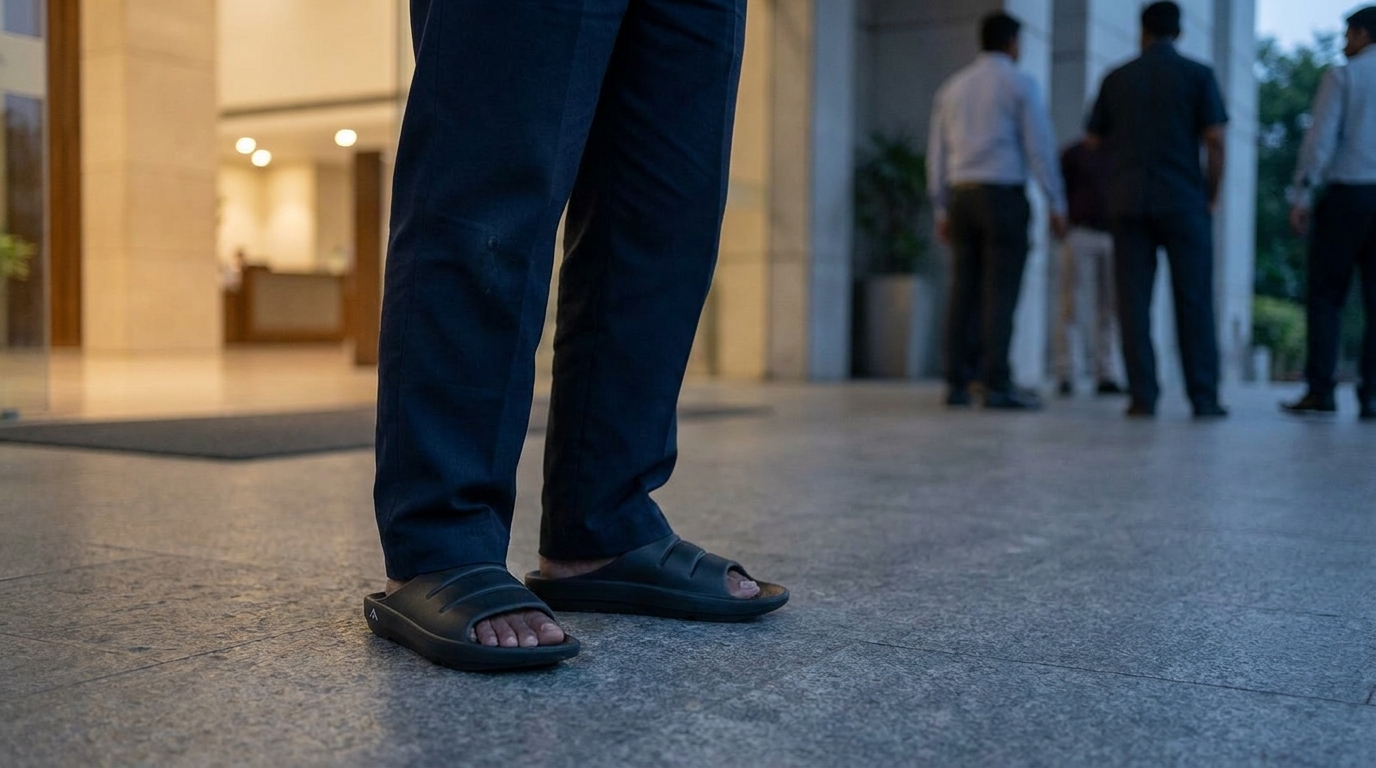
On a flat sole, the parts touching are the heel and the ball. The arch curves away from the surface and carries nothing, so those two areas carry everything, and the peak pressure at each of them is as high as it is going to get. At hour one you do not notice. At hour nine you do, and it is usually the heel that mentions it first.
A contoured footbed changes the area, not the force. Fill the gap under the arch and the middle of the foot makes contact along its length. Same weight, spread over more of the sole, lower peak at the two spots that had been carrying it alone. That is all the ArcFit™ footbed is doing, and it is the same footbed in all five of our styles. A redistribution. Not a cure.
Most of what helps is not a shoe
Before you buy anything, this is the honest order of operations. If any of these are within your control, they are worth more than a change of footwear:
- A rubber anti-fatigue mat where you actually stand. If your employer will put one down, that is a bigger change to your day than any pair of shoes, ours included.
- A stool behind the counter, or a rail low enough to rest one foot on, so one leg can leave the arrangement for a minute.
- Sitting when the work allows it, even briefly, even when it looks like slacking.
- A second pair kept at work and swapped halfway through, so the shape under your foot is not identical for twelve straight hours.
We are not going to attach a percentage to any of those. We have not measured them, and neither has anyone else who is trying to sell you something.
What changing your footwear can and can't do
Here is the part we are actually responsible for.
A contoured footbed only works if the foot is sitting where the contour is, which is what the deep heel cup is for. Without it the heel drifts a few millimetres every time you shift your weight, the arch shape ends up under the wrong part of the foot, and you are back to a flat sole with a nice profile drawn on it.
The foam matters for a different reason. The usual way to make a soft sole is to cut it from a sheet of EVA, which is one continuous material, and continuous material takes a set: hold it compressed for long enough and it stays compressed. CloudFoam™ is made the other way round. The foam is expanded into granules and then fused into the shape of the sole in a single mould, so you are standing on thousands of small pieces rather than one block. Each granule compresses and rebounds on its own. It packs down more slowly than a slab does. How many months yours will last, we can't tell you, because we have not measured that either.
Weight helps too, and it is the one number we will quote: roughly 120 g per shoe at EU 42. That is the only size we have put on a scale, so it is the only size we will claim.
Now the other column, which most footwear sites leave out:
- This is not a medical device and we are not going to imply it is. If your feet hurt in a way that worries you, see a doctor first and buy footwear second.
- It does not make a twelve-hour shift feel like an eight-hour one.
- It does not replace sitting down. Nothing you can wear unloads a foot the way stepping off the floor does.
- It does nothing about the floor itself, the hours, or the two hundred other things a shift asks of you.
We make indoor shoes on purpose, and this is the reason
CloudFoam is heat-sensitive, and that is not a footnote. It is the trade we made.
Keep away from direct sunlight & heat, CloudFoam™ is heat-sensitive and can shrink or deform. That includes hot water: rinse cold or lukewarm, never hot, and never tumble-dry. The pair is waterproof; it is heat in any form, water included, that damages the foam. Heat damage is not covered by returns.
A foam soft enough to give way under a heel at the end of a long shift is a foam that also gives way on a dashboard in June. A compound hard enough to survive the dashboard would do nothing for the floor you stand on all day. We picked the floor. So these belong on a ward, a shop floor, a kitchen line or a salon floor, and they do not belong on a terrace in May, drying on a windowsill, or in a parked car. Four ways a pair gets ruined is the whole list, and what returns cover says plainly that heat damage is not one of them.
Which pair for which floor?
The footbed, the foam and the outsole are identical in all five styles. Only the upper is different, which is why there is one price across the range and why picking between them is a question about shape, never about which one we would rather sell you.
- Halo Clog, closed toe, drilled through for drainage. The first one to look at for a kitchen line or a ward floor, where things land on the floor and you want your foot covered.
- Ultimate Flip Flop, toe post, open. Quick on and off for breaks and the walk out.
- Ardour Flip Flop, toe post, open. Same idea as the Ultimate with a different upper.
- Aroma Pro Slide, one strap, no toe post. The easiest to get into when your feet have had enough, and nothing between the toes.
- Adventure Slide, one strap, no toe post.
Whether the closed one or an open one is right for the shift itself is usually decided by your workplace rather than by us. If it helps to read it by job, there are pages for long standing shifts, nurses and hospital staff, retail and hospitality, the hour after training and wearing them at home. Same five styles behind all of them.
Read this before you order
Sizing is unisex, EU 38–46 and IND-UK 5–11. Returns cover manufacturing defects, damage on arrival or a wrong item, reported within 7 days, with free reverse pickup on accepted claims. There is no change-of-mind window and no size swap, which makes the size the one part of this order worth slowing down on. The fit quiz takes four questions, and every product page has a converter on it.
Shipping in India is free express, 2 to 5 days. Nobody has published a review on this site, because nobody has left one, and the two of us could write ten convincing ones tonight, which is exactly why there are none. Who is behind this has the rest of it.
Common questions
Are these all right for a twelve-hour hospital shift?
The Halo Clog is the one built for that end of the range: closed toe, drainage drilled through the upper, a geometric non-slip outsole, the same ArcFit™ footbed as everything else, and roughly 120 g per shoe at EU 42. It is waterproof end to end, so a spill is a rinse rather than a ruined pair. What we won't tell you is that it makes twelve hours feel like six.
Can I wear them outside on the way home?
A walk to the bus in normal weather is fine. What ruins a pair is heat rather than distance: a closed car in the sun, a terrace or a windowsill they were left on to dry, a heater, a dryer, or a hot rinse at the end of the day. Rinse cold or lukewarm and dry them indoors in the shade.
Will they help my heel pain?
We can tell you the mechanism and then we have to stop. A contoured footbed puts more of the foot in contact with the sole, and pressure is force divided by area, so the peak under the heel comes down. Whether that helps your heel is not something we can answer from here, and any brand that answers it for you is guessing. Heel pain that keeps coming back is a doctor's question, not a shopping question.
What happens if the size is wrong?
Then you own a pair that does not fit, which is the honest answer. Returns are defect-only, so a wrong size is not a return and there are no swaps. Use the fit quiz and the converter on the product page before you order, and if you land between two sizes, ask us first rather than after. The full policy is on the returns page, and the rest of the range is in the shop.
The foam is heat-sensitive and that is on every product page above the button. Everything else we can't do is in the guides.