What recovery footwear actually does, and what it doesn't
Posted by Fanture, Surat, Gujarat. Who that is
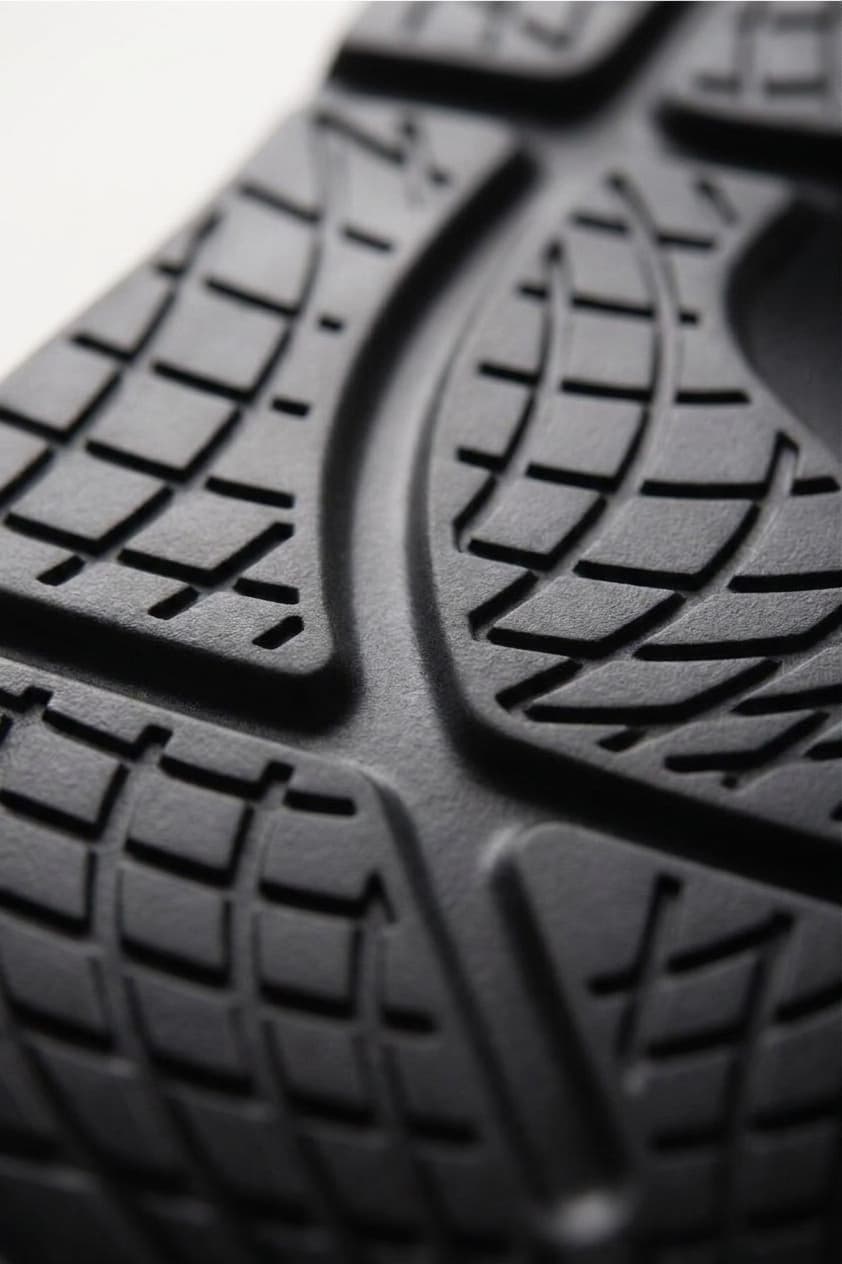
Recovery footwear spreads your body weight across more of your foot than a flat sole does. That is the mechanism, and there is no second one hiding behind it. A footbed shaped like the underside of a foot makes contact along the arch instead of leaving it over open space, and pressure is force divided by area, so the same weight resting on more area means a lower peak in the places that were carrying the most of it. What none of that is, is medicine. It treats nothing, it diagnoses nothing, and if your feet hurt in a way that worries you, that belongs in front of a doctor long before it belongs in a shopping cart.
Pressure is force divided by area, and that is the whole of it
You weigh what you weigh. Put on a different pair of shoes and the number on the scale is unchanged, so nothing about footwear reduces the load going into the floor. The only thing a sole can change is how that load is shared out underneath you.
Stand on a flat sole and your arch spans a gap. It is not touching anything, so it is not carrying anything, and whatever it isn't carrying has to land somewhere else. It lands on the heel and on the ball of the foot, because those are the two areas still in contact with the ground. Small areas, whole body weight.
A contoured footbed fills that gap. The middle of your foot makes contact, the contact area gets bigger, and the same force divided by a bigger number is a smaller number. That is why the shape of a footbed matters more than how thick it is. A very soft flat slab still leaves the arch over air. A firm contour that follows the foot does not. Ours is the ArcFit™ shape, and it is the same contour in every style we make.
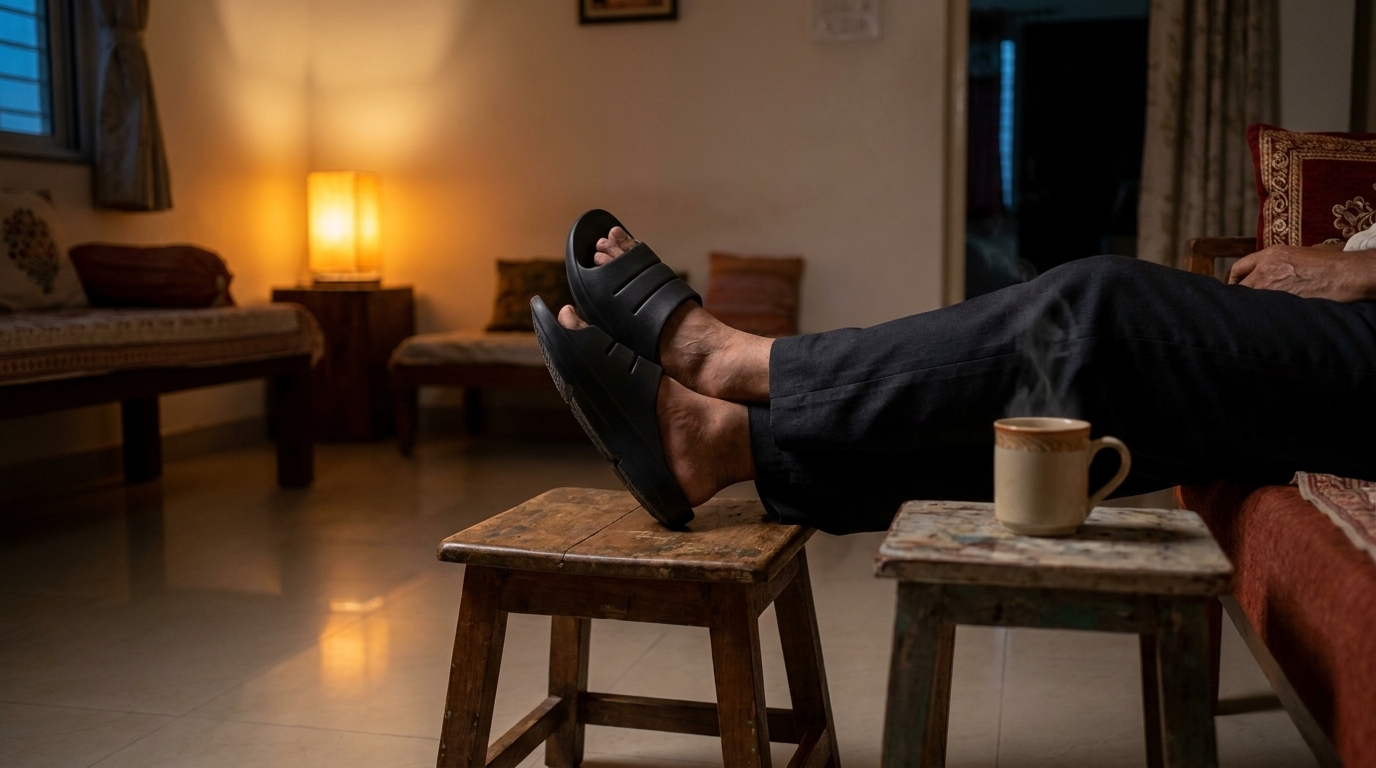
Why is standing still harder on a foot than walking?
Most people have this backwards. Walking covers distance, so it looks like the demanding one, but it unloads each foot every single step. Load, release, load, release. A foot in the air is carrying nothing.
Standing still never gives you that. The same two areas stay under the same load for the length of a shift, and the arch stays spanning air the whole time, with no step to interrupt it. Add a floor with no give in it, which is what most workplaces have under the vinyl, and the case gets harder again. Hospital wards, shop counters, kitchen lines, salon floors. That is the situation we build for and it is the situation this mechanism is aimed at.
If that is your day, the guides for long shifts, nurses and healthcare and retail and hospitality go into it room by room. Gym and home use have their own: post-workout and everyday at home.
The heel cup decides whether any of it works
A shaped footbed only does something if your foot is sitting where the shape is. Move the foot a few millimetres and the contour ends up under the wrong part of it, which is the same as not having a contour at all.
That is the job of the deep cup around the heel. It holds the heel in one place so the arch shape stays under the arch for the whole time the shoe is on. It is the least visible part of the shoe and the part that stops the rest from being decoration.
What the foam is doing while you stand on it
The common way to build a soft sole is to cut and press a sheet of EVA. One continuous material, which is exactly what takes a permanent set: compress it long enough and it stays compressed. That is the sandal that feels good for a while and flat afterwards.
CloudFoam™ is made the other way round. The foam is expanded into granules first, then fused into the sole shape in a single mould, so you are standing on thousands of small pieces rather than one block. Each compresses and rebounds on its own, and the boundaries between them give the material somewhere to deform into and a route back out. It packs down more slowly than a slab does.
How long yours will last, we can't tell you. We have not measured it, and a brand quoting you a figure for it probably hasn't either. The full breakdown is on the technology page.
What recovery footwear is not
Here is the part that most pages like this one skip.
- Not a medical device. We have never registered it as one, and nothing on this site should be read as if we had. It is footwear.
- Not an orthotic. A real orthotic is prescribed or made for one person's foot after someone qualified has looked at that foot. Ours is a moulded shape produced in EU 38 to 46, and everyone who buys a given size gets the same contour. They are different objects, and one is not a cheaper version of the other.
- Not a treatment. We are not going to tell you this fixes plantar fasciitis, or heel pain, or anything else with a name. We don't know that, nobody has tested it, and a sentence like that would be worth more to us than it would be to you.
- Not a diagnosis, and not a reason to delay one. A shoe cannot tell you what is wrong. If something is wrong, the shoe is also not the thing that finds out.
Everything we are willing to say about this product describes shape and material. Where your weight sits on a contour is geometry. What happens to a particular pair of feet over a particular number of hours is not ours to promise, so we don't.
If your feet hurt in a way that worries you, start with a doctor
Buy footwear second. That is not a legal line at the bottom of a page, it is the order of operations.
Pain that is new, pain that doesn't settle once you are off your feet, numbness, or anything happening alongside a condition that affects your circulation or your feet: none of that is a footwear question, and none of it gets answered by a purchase. A doctor or a podiatrist can tell you what you are dealing with. Then, if better weight distribution while you stand is part of what would help, you know what you are shopping for and why.
We would rather lose the sale to that advice than have it.
What can a pair honestly be expected to change?
One thing. Where your weight sits while you are standing on it, and how much of your foot is sharing the job.
Whether that adds up to something you notice at hour nine depends on your floor, your hours, your feet and what you were wearing before. We have no measurement of it and no customer to quote at you, because we haven't sold a pair through this site yet and we are not going to invent one. If a brand hands you a percentage for how much pressure a recovery shoe removes, ask who took the reading, on what instrument, and on how many pairs. We couldn't answer that about our own shoes, which is why no percentage appears anywhere on this site.
The thing that ruins a pair is heat, not your feet
CloudFoam™ is heat-sensitive. Direct sunlight, a closed car, a room heater, a tumble dryer and hot water will all deform it, and heat damage is not covered. Rinse cold or lukewarm, and dry the pair indoors, in shade.
We chose the foam knowing that. Softness at hour nine and survival on a dashboard are the same property pulling in two directions, and we optimised for the floor you actually stand on. We made that call, in Surat, and the consequence is printed on product pages above the button rather than in a warranty clause.
Five shapes sit on the same footbed
The footbed, the foam and the outsole are identical across the range. All that changes is how much of your foot the upper covers, which is why the styles cost the same and why your decision is shape rather than performance.
- Ultimate and Ardour are toe-post flip flops, the most open of the five.
- Aroma Pro and Adventure are single-strap slides, no toe post, which suits anyone who dislikes something sitting between their toes.
- Halo is a closed clog, drilled through for drainage, and it is the one that makes sense on a kitchen line or a ward where things get spilled.
Sizes run EU 38 to 46 and IND-UK 5 to 11, unisex across the range. A shoe weighs around 120 g at EU 42, the only size we have weighed, so it is the only size we quote. The whole range is on the shop page, and the fit quiz is four questions about what you stand on all day.
Questions people ask
Is recovery footwear a medical device?
No. Ours is not registered as one and we make no medical claim about it anywhere on this site. It is a shoe with a contoured footbed. If you need a device, you need someone qualified to prescribe it.
Will this help my foot pain?
We can't tell you that, and a brand that does is guessing on your behalf. What we can tell you is the physical change: a contoured footbed puts your arch in contact with the sole and lowers the peak pressure under your heel and the ball of your foot. Whether that is relevant to your pain is a question for a doctor.
Can I return a pair if my feet don't feel any different?
No. Returns here are defect-only, within 7 days, for a manufacturing defect, damage on arrival or the wrong item, with free reverse pickup when a claim is accepted. There is no change-of-mind return and no size swap, which is why this paragraph exists. The full policy is on the returns page.
Is it worth it if I walk all day rather than stand?
Walking gives your feet the release that standing doesn't, so the case is weaker. The mechanism still applies, because a contoured footbed spreads load whenever you are on it. But the situation these are aimed at is a person holding still on a hard floor for hours, and we would rather say so than pretend every use is equal. Who we are and what else we refuse to claim is on the about page.
The foam is heat-sensitive and that is on every product page above the button. Everything else we can't do is in the guides.