
- 01The closed toe is about spills and dropped items, not about protection ratings.
- 02Grip on a mopped floor comes from channels that let water escape, not from the material being described as grippy.
- 03Waterproof matters because you will actually clean a shoe that rinses in thirty seconds.
- 04Where your workplace specifies rated footwear, wear the rated footwear.
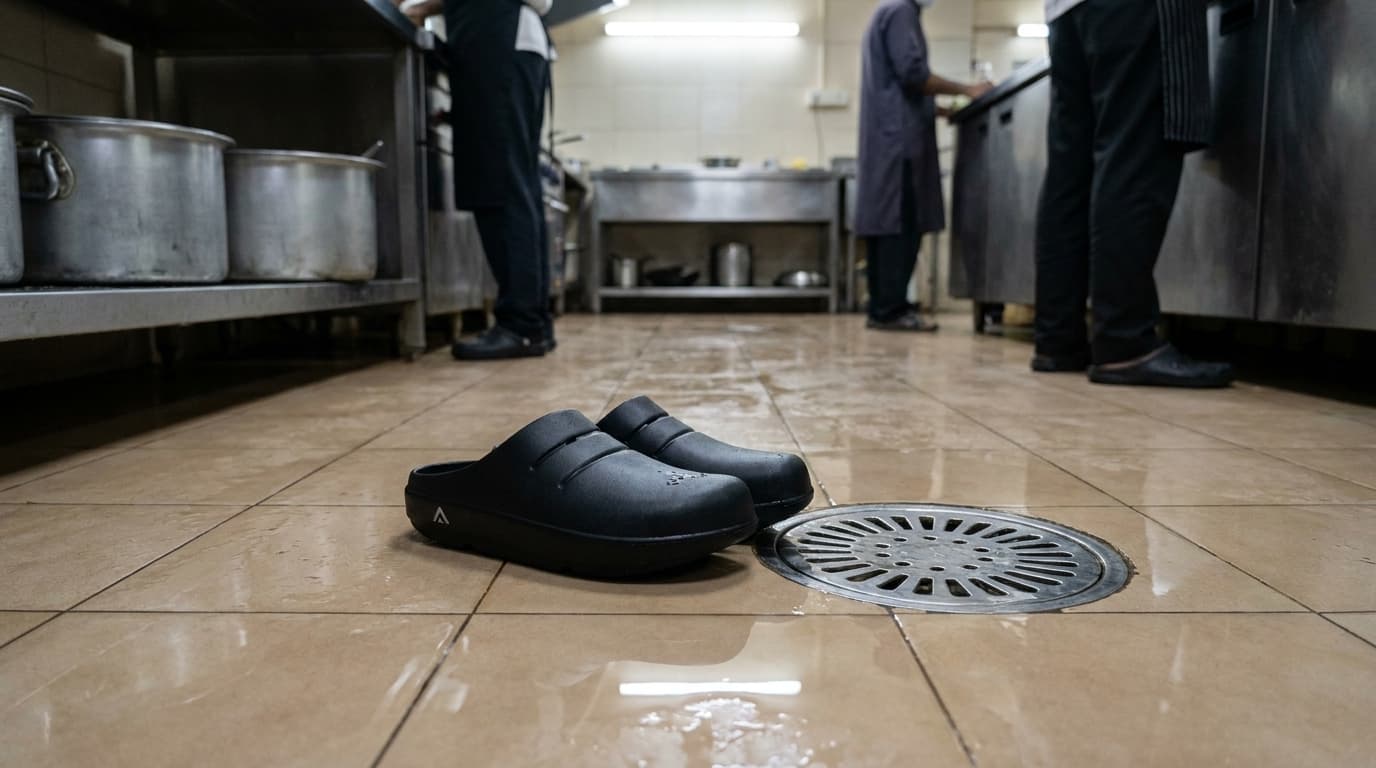
A kitchen or a ward asks four things of a shoe at once: stand on a hard floor for ten hours, cope with spills, hold on a mopped surface, and be clean again by the next shift. A clog answers all four, which is why kitchens standardised on the shape decades before recovery foam existed. This guide covers what to look for, where our own closed style fits, and the boundary we will not talk our way around, none of this is certified safety footwear.
Why the shape suits the shift
Kitchens and wards are floored in whatever mops cleanest, and none of it gives under a foot. Ten hours of that is sustained load in the same two places, which is a problem a shaped footbed and a foam that springs back can genuinely reduce.
The closed upper adds the part an open slide cannot: your toes are covered when something is dropped or spilled, and the shoe stays on when you move fast around a corner. It still goes on without laces, which is the reason it survives in places where people change footwear at a door.
What to check in a work clog
- Drainage through the upper
- A closed foam shoe with no holes is a bucket. Ours is drilled through so a spill drains rather than pooling around the foot, which is the same idea as the channels in the outsole applied one level up.
- A tread cut for water, not just textured
- A mopped floor is slippery because of the film of water on it. Channels through the tread give that film somewhere to go so the sole can touch the floor. Texture alone does not do this.
- Something you can genuinely rinse
- Fabric holds spills and smells and takes days to dry. One piece of waterproof foam takes thirty seconds under a tap, which is the difference between a shoe you clean and a shoe you mean to clean.
- Weight, over a ten-hour shift
- Roughly 120 g per shoe at EU 42 here. Multiply any weight by the number of steps in a shift and it stops being a specification.
The line we will not cross
This is comfort footwear. It is not steel-toed, it carries no puncture protection and it has no slip-resistance rating, and we are not going to describe it in careful phrasing that lets you assume otherwise.
If your kitchen or your hospital specifies certified footwear, that requirement wins and this is not it. Where the choice is genuinely yours, and for the commute, the break and the hours after you clock off, a closed recovery clog is a good answer to the same day.
Our closed style, and its one weakness
The Halo is the only closed shape in the range. Same contoured footbed, same fused foam, same outsole as everything else; the difference is the upper, and it is the one to buy if your day is spent on tile.
Its weakness is heat, in two senses. It is the warmest shape to wear because it is the most enclosed, which is the honest cost of the coverage. And like everything we make, the foam is heat-sensitive: no drying on a terrace after a shift, no leaving it in a car, no hot water in the wash. That damage is not covered by returns, and a shoe that lives in a hot kitchen is fine, it is the terrace afterwards that gets it.
Where this guide stops
Nobody here has worn these through a hospital rota and written it up, and we do not have a slip test. What is on this page is what the shoe is made of and what each part is shaped to do. Whether it beats what you are wearing now is something you will know inside one shift, which is a shorter wait than any claim we could make.
CloudFoam™ is heat-sensitive, keep every pair out of direct sunlight and off hot surfaces, and store it in the shade. Sun or heat damage isn't covered by returns.


