
- 01The problem is sustained load in two places, not impact. Look for a footbed shaped to make contact under the arch, not a thicker sole.
- 02Foam that springs back matters more than foam that feels soft in the shop. A sole that packs flat has stopped working even though it still looks the same.
- 03Weight compounds. You lift each shoe thousands of times a shift, so grams are not a spec-sheet detail.
- 04If your job mandates certified safety footwear, that rule wins. Nothing in our range is rated for it.
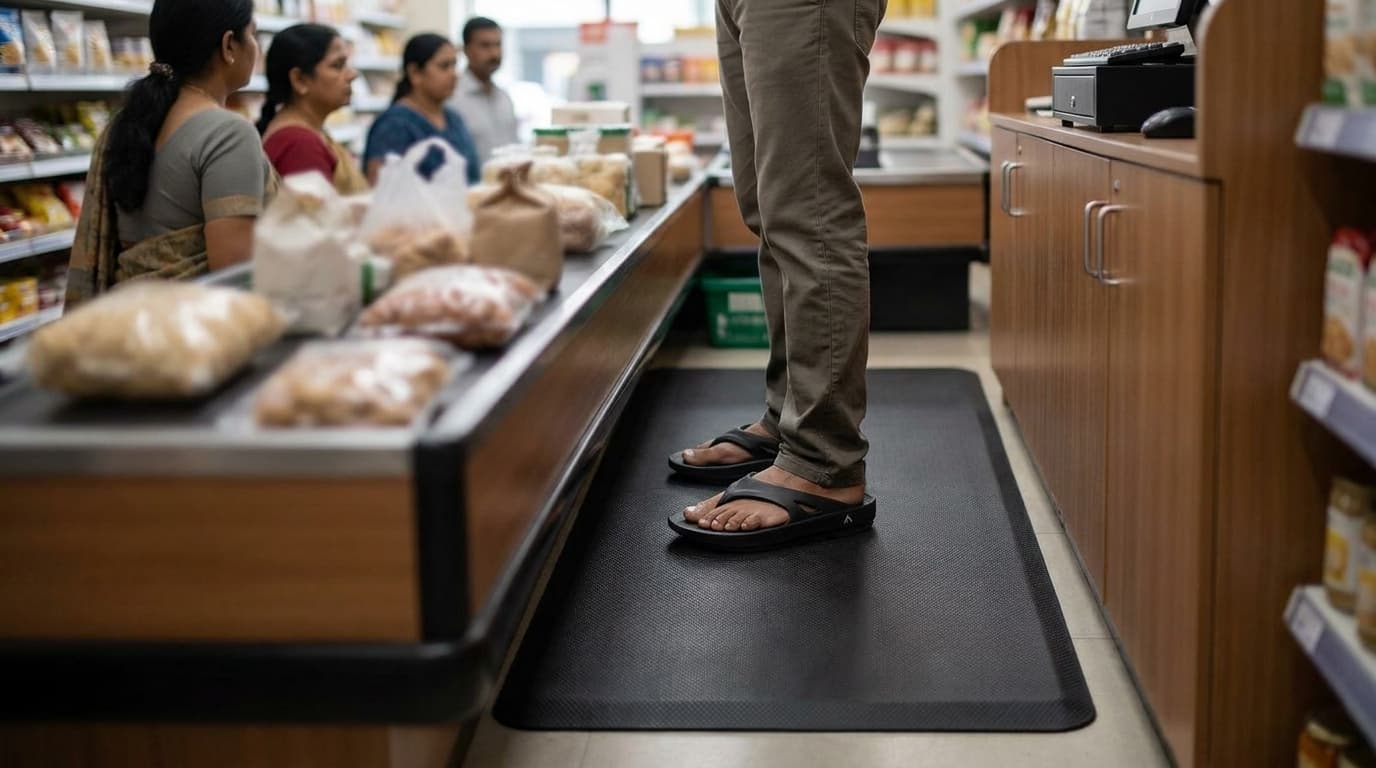
Eight hours of standing is not eight hours of walking taken slowly. Walking passes your weight from one foot to the other and back again, and every handover is a rest the foot takes without you noticing. Standing removes the handover. The heel and the ball of the foot hold the same load for the length of the shift, and on tile or concrete there is nothing underneath them that gives. This guide is for the people who do that for a living, ward staff, counter staff, kitchen lines, salon floors, shop floors. It covers what to check before you spend anything, what footwear can honestly do about a long shift, and the jobs we would tell you not to buy our own pair for.
Why is standing harder on your feet than walking?
In a walking stride each foot is completely unloaded for a fraction of a second while the other one carries you. That gap is short, but it repeats a few thousand times an hour, and it is when blood moves and the small muscles that hold the arch let go.
Stand still and the gap never comes. Your weight sits on the heel and the ball of the foot continuously, the arch muscles hold a static contraction for hours instead of pulsing, and blood pools rather than being pumped along. The tiredness that arrives at hour seven is not damage. It is the bill for a load that was never put down.
Hard flooring is the second half of the problem. Hospital corridors, kitchens, showrooms and factory lines are finished in whatever mops cleanest, tile, vinyl, concrete, steel, and none of it deforms under a foot. On a surface with no give, everything that gets absorbed is absorbed by you.
Five things worth checking before you buy anything
This list is not about our range. It is what separates footwear that helps on a shift from footwear that is merely soft on day one, whoever makes it.
- Shape before thickness
- A dead-flat sole leaves your arch spanning air, so the heel and forefoot take everything. A footbed contoured to meet the arch puts more of the foot in contact with the sole, and pressure is force divided by area, widen the area and the pressure at the two loaded spots drops. A thick flat sole does not do this. A thinner contoured one does.
- Foam that comes back
- Almost anything feels good for an hour. What you want to know is what it feels like in month four. Cheap foam takes a set: hold it compressed long enough and it stays compressed, and it stops being cushioning while still looking exactly like cushioning.
- Weight, because it multiplies
- You lift each shoe with every step, and on a shift that is thousands of lifts. A heavy pair is a small tax charged very often. Ours run roughly 120 g per shoe at EU 42, that is the size we have weighed, and bigger sizes use more foam.
- A tread cut for wet floors
- Wet floors are slippery because a film of water sits between the sole and the surface and stops the two from touching. A tread with channels through it gives that water somewhere to go. A smooth sole, however grippy the material claims to be, has nowhere to put it.
- Whether you can get it off
- A pair you can step out of at a locker, a scrub area or a back room actually gets used at the moments you most want it. Laces get skipped.
What footwear can honestly do about a long shift
It can reduce how much work your feet do to hold you up, and it can stop the floor being the hardest thing in the room. That is a real difference and most people feel it by the end of the first shift.
It cannot treat anything. If your feet hurt in a way that wakes you at night, or the pain is in one spot and sharp, or it started suddenly, that is a question for a doctor and not for a shoe. We are not going to tell you otherwise to move a pair.
It also does not replace sitting down. Two minutes off your feet every hour does more than any sole, and no footwear anyone sells is a substitute for a break you are entitled to.
Where our range fits, and the jobs we would not sell to
Fanture is designed in Surat, Gujarat for indoor standing work. Every one of the 5 styles sits on the same contoured footbed and the same fused-foam sole, and the range covers EU 38–46 unisex.
Indoor standing work is who we build for, not a restriction on where you can wear them, everyday outdoor wear is fine. The limitation is heat, and it is a limitation rather than a preference. CloudFoam™ is heat-sensitive: direct sun, a hot car, a heater or hot water can shrink or deform it, and that damage is not covered by returns. So if your shift is on a roof, a forecourt, a construction site or anywhere else that means eight hours in the sun, we would rather you did not buy these than have you learn that in June.
What we do about it is put the warning on the product page above the button rather than in a warranty clause, print it on a card in the box, and dry-and-store advice on every care page we publish. The foam is soft because soft is what a hard floor needs. The same softness is what the dashboard gets at.
If your workplace mandates safety footwear
Nothing we make is certified safety footwear. There is no steel toe, no puncture plate and no slip-resistance rating on any of it, and we are not going to imply one by describing the tread in careful language.
Where a kitchen, a ward or a plant specifies rated footwear, wear the rated footwear. Those rules exist because someone dropped something. A recovery pair is for the commute, the break room and the hours after you clock off, and that is a real part of the day.
Where this guide stops
We have not put these on a ward for a fortnight and measured anything, and nobody here has a pressure plate. Everything above is either how the mechanism works or how we built the shoe, where a competitor would print a percentage, we have an explanation instead, and you can check it against your own feet in a week.
CloudFoam™ is heat-sensitive, keep every pair out of direct sunlight and off hot surfaces, and store it in the shade. Sun or heat damage isn't covered by returns.


