
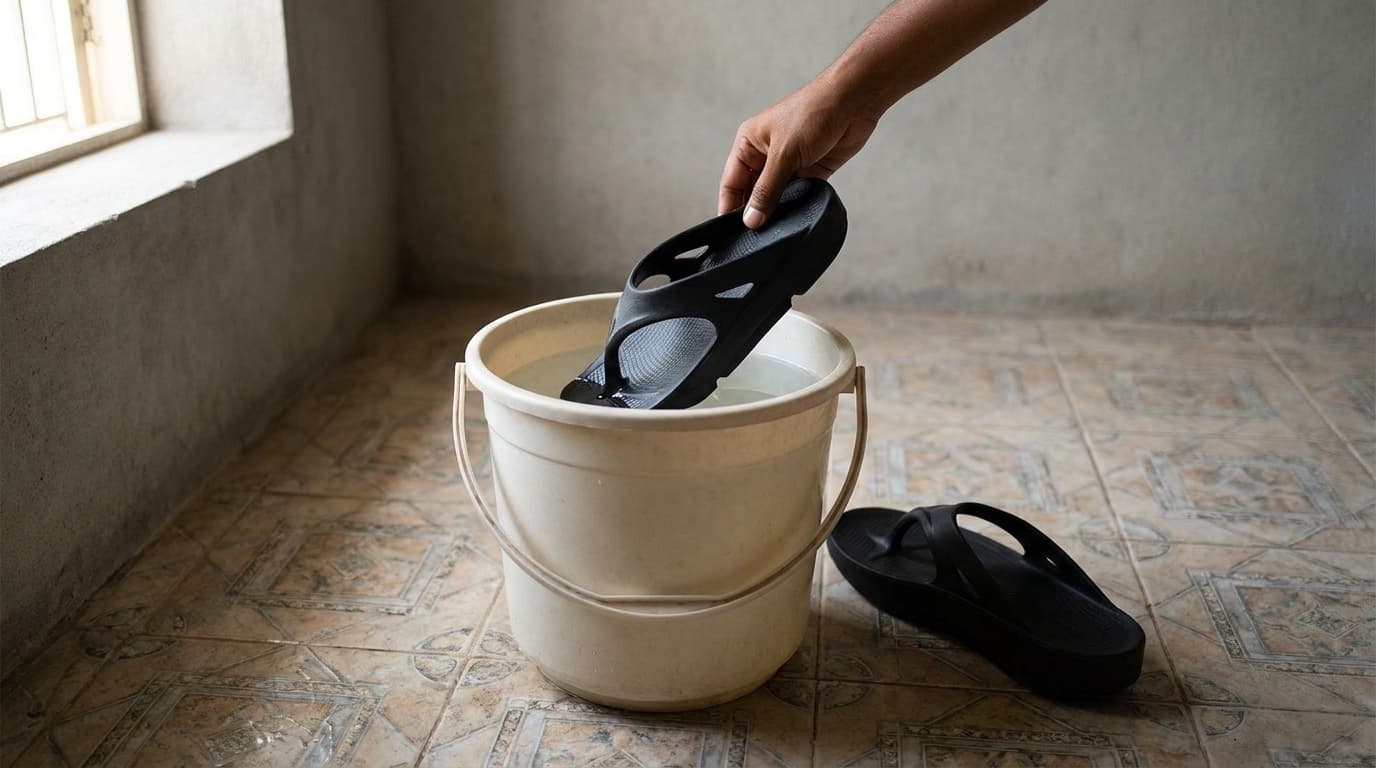
- 01Cold or lukewarm water, mild soap, soft brush. That is the whole cleaning method.
- 02Heat deforms the foam permanently, and heat damage is not covered by returns.
- 03The dangerous heat is usually not a fire or a stove. It is a terrace, a parked car, a geyser and a room heater.
Foam footwear asks almost nothing of you. No polish, no products, no drying racks, a rinse under a tap and you are done, because there is no lining, no fabric and no insole glued in to get wet. There is exactly one way to destroy a pair, and it is heat. This guide covers the four situations that actually do it, what the heat is doing while it happens, and the two-minute wash that is all the maintenance these ever need.
The four ways a pair actually gets ruined
These are not theoretical. They are the four situations where an otherwise fine pair goes out of shape, and none of them feels like mistreatment at the time.
- Drying on a terrace, a balcony or a sunny windowsill
- The surface of the foam shrinks faster than the core, so the sole curls and the footbed loses the contour it was moulded with. Dry them indoors, out of direct light. They are quick-drying anyway, the sun buys you nothing but risk.
- A parked car: dashboard, parcel shelf, boot
- A closed cabin in the sun gets far hotter than the air outside it, and the foam softens and takes the shape of whatever it is pressed against. Keep the pair in the footwell, or carry it inside with you.
- Hot water, a hot rinse, a wash cycle, a bucket off the geyser
- The pair is waterproof, which makes it look washable at any temperature. It is the temperature doing the damage, not the water. Rinse cold or lukewarm, with a little mild soap if the week has been rough.
- A room heater, a radiator, a tumble dryer, a hair dryer
- The same effect as the sun, only closer, faster, and applied to one side of the shoe at a time. Air only, at any setting.
Why we picked a foam that has this problem
Because the property that fails in heat is the property that works on a floor. A fused-granule foam is soft enough to give under a heel at the end of a long shift and springy enough to come back for the next step, and a compound hard enough to shrug off a dashboard would do neither.
We could have made a harder shoe that survives a car in May and does nothing for a ten-hour shift. We chose the shift. What we do about the consequence is state it before the buy button rather than in a warranty clause, print it on a card in the box, and repeat it here, because the failure is entirely avoidable and takes one habit to avoid.
Heat damage is not covered by returns. That is not a loophole we are hiding behind; it is the reason the warning is everywhere on this site rather than in small type.
The two-minute wash
There is no lining and no removable insole, so washing the shoe is washing all of it. Nothing needs to come apart and nothing can get trapped wet inside.
- 1, Rinse
- Cold or lukewarm tap water. A little mild soap if they need it. Skip bleach, solvents and anything described as heavy duty; none of it is necessary and some of it is hard on foam.
- 2, Brush the tread
- A soft brush through the channels in the outsole. That is where grip on a wet floor actually lives and it is the first thing to clog with grit. The textured footbed holds dirt for the same reason it feels good.
- 3, Shake and stand
- Water leaves through the drainage channels. Shake once and stand them somewhere indoors with air moving across them.
- 4, Wait
- No machine, no dryer, no heater, no sun. The moment you decide to speed it up is the moment the pair gets damaged, and drying was never the slow part anyway.
Storing them, and the habits that add up
Store cool and out of direct light. A rack indoors is fine. A sunny balcony, a car boot or a bag left in a hot vehicle is where pairs die, usually in one afternoon.
Rinse after the beach, a pool or a muddy monsoon walk so salt and grit do not work into the tread. If you own two pairs, alternating them gives each one time to dry out fully, which is the only thing that keeps foam footwear from smelling.
If a pair has already warped
It does not come back. Foam that has shrunk or deformed under heat has taken a new shape, and there is no soaking, weighting or reheating that returns the old one. We would rather tell you that than sell you a fix.
What is worth checking is whether the damage is heat at all. A sole that has flattened evenly under both heels over months is wear, not heat. A sole that has curled at the edges or a footbed that has lost its contour on one side is heat, and the pair usually sat somewhere sunny.
Where this guide stops
We cannot give you a temperature or a number of hours. Nobody here has tested a pair to failure under controlled heat, so we are not going to invent a threshold that sounds authoritative. The rule we can defend is the categorical one: no direct sun, no hot surfaces, no hot water, no appliance that heats. Everything above that line is guessing, and it is your pair.
CloudFoam™ is heat-sensitive, keep every pair out of direct sunlight and off hot surfaces, and store it in the shade. Sun or heat damage isn't covered by returns.


