
- 01A slide gives a warm, tired foot room to spread and a shaped surface to rest on. That is real and immediate.
- 02It does not repair muscle or speed recovery in any medical sense, and we will not say it does.
- 03Waterproof and rinse-clean matters more than it sounds: gym floors and shower blocks are the environment.
An hour in trainers leaves the foot warm, slightly swollen and held in a shape somebody else chose. The appeal of a recovery slide is not complicated: step out of that and into something wide, soft and shaped, and the walk to the car feels different. That is the whole claim, and this guide is mostly about keeping it that size, because the category has attracted a lot of language about muscle repair that nobody selling slides can support.
What an hour in trainers does to a foot
Your foot is held in a snug shoe, usually sweating, taking repeated load from every jump, sprint and step. Toes stay slightly compressed, the arch works, and the whole foot is warmer and a little larger at the end than it was at the start.
Stepping straight back into the same closed shoe for the commute keeps all of that going for another half hour. A wide open band lets the foot spread and the heat out, while a shaped footbed underneath means the alternative to a tight shoe is not a bare locker-room floor.
That is the mechanism, and it is not dramatic. It is comfort, arriving at the moment your feet are least willing to negotiate.
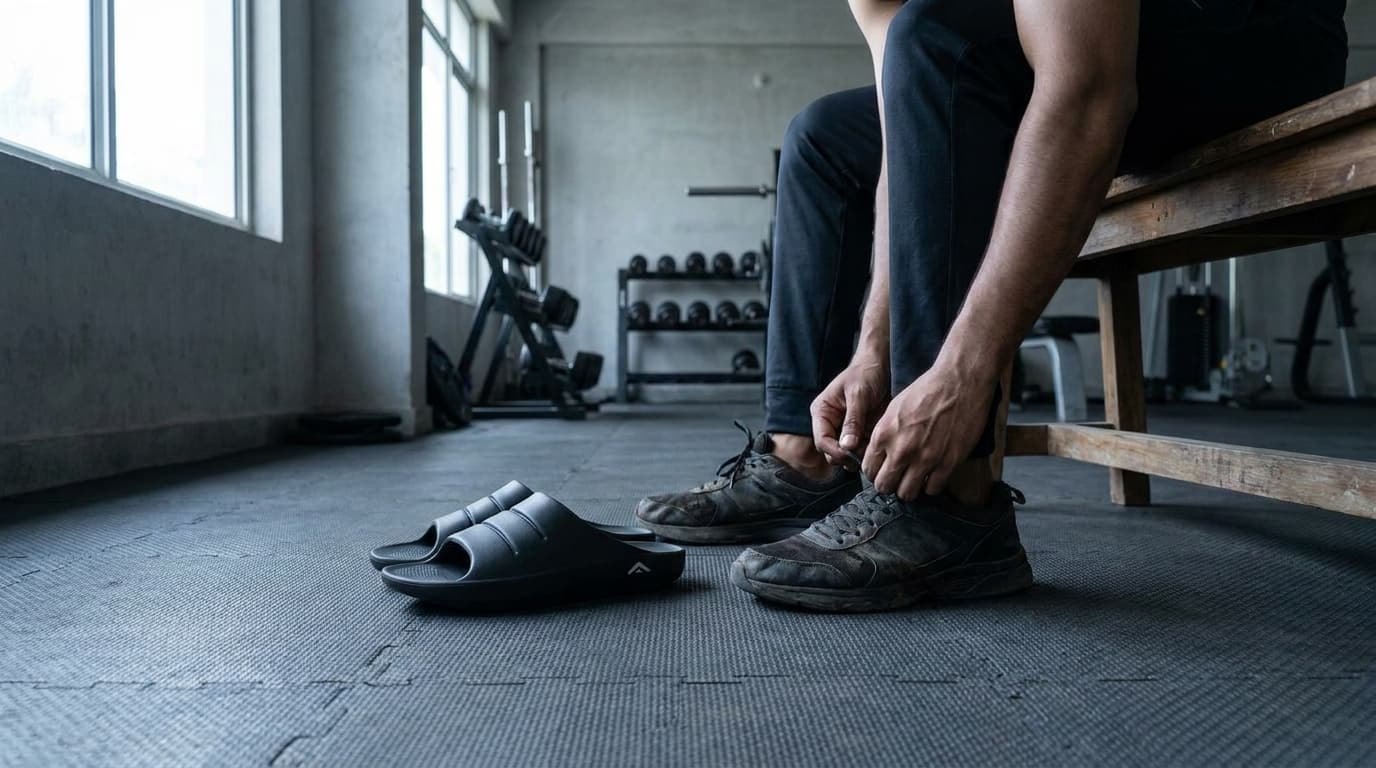
The claim we are not going to make
A slide does not repair muscle, flush anything, or shorten how long you ache. There is no version of this shoe that is a treatment, and a brand that tells you otherwise is either guessing or hoping you will not ask.
If you want to know whether it helps you, the test is cheap and it is yours: wear it for the walk out and the evening after a hard session and see whether you notice. That is a better standard than any percentage we could print, and it is the only one we have.
What makes a slide worth keeping in the bag
Speed, first. If getting them on requires a hand, a toe post or a bend, they stay in the bag. One wide band is why the slide rather than the flip flop is the gym shape.
Then the sole. Foam that packs flat is a slide that felt great in March and does nothing in July; fused granules spring back for longer because you are standing on thousands of small springs rather than one block that has taken a set.
Then water. Gym floors, showers and pool decks are wet and shared. A fully waterproof pair with a cut tread that rinses under a tap in seconds earns its place fast, and there is no fabric in it to hold on to a changing room.
And weight, because it lives in a bag you are already carrying. Roughly 120 g per shoe at EU 42 is the figure we have actually weighed.
One warning specific to gym bags
The bag goes in the car. The car sits in the sun. That is the single most common way a pair of these gets deformed, and it happens to gym pairs more than to any other kind.
CloudFoam™ is heat-sensitive: a closed cabin in the sun gets far hotter than the air outside, and the foam softens and takes the shape of whatever it is pressed against inside the bag. Heat damage is not covered by returns. Carry the bag inside, or leave the pair in the footwell.
Where this guide stops
There is no study behind this page and no measurement of anything. We build the shoe, so we can tell you exactly what is in it and what it is shaped to do; whether a wide cushioned base after training makes your evening better is a question only your own feet answer, over about a week.
CloudFoam™ is heat-sensitive, keep every pair out of direct sunlight and off hot surfaces, and store it in the shade. Sun or heat damage isn't covered by returns.


