
- 01Recovery describes a comfort category, not a medical one. Nothing in it treats, cures or prevents anything.
- 02Three parts decide whether the word is earned: the shape of the footbed, the kind of foam under it, and the heel cup that keeps your foot where the shape is.
- 03Softness on its own is not recovery. A thick flat sole is a thick flat sole.
Recovery went from a niche idea to a sticker on half the slides in the market in about three years. Some of what carries the word is genuinely designed; some of it is a soft sole and a print run. Nobody polices the term, so the only way to tell is to know which parts of the shoe the word is supposed to be describing. This is that list, plus an answer to the question most explainers skip: who should not buy one.
What "recovery" is supposed to mean
The word describes footwear meant for the low-effort parts of the day, after training, on the walk home, around the house, standing at a counter, rather than for the effort itself. Against a thin flat sandal or a hard-soled shoe, a recovery pair is thicker, softer and shaped rather than level, so the foot rests on a supportive base instead of a hard one.
That is the entire claim, and it is smaller than the marketing around it. A recovery shoe does not repair muscle, speed healing or treat a condition. Any brand telling you otherwise has crossed from describing a product into practising medicine, and in India that is also an ASCI and Consumer Protection Act problem, not only a taste one.
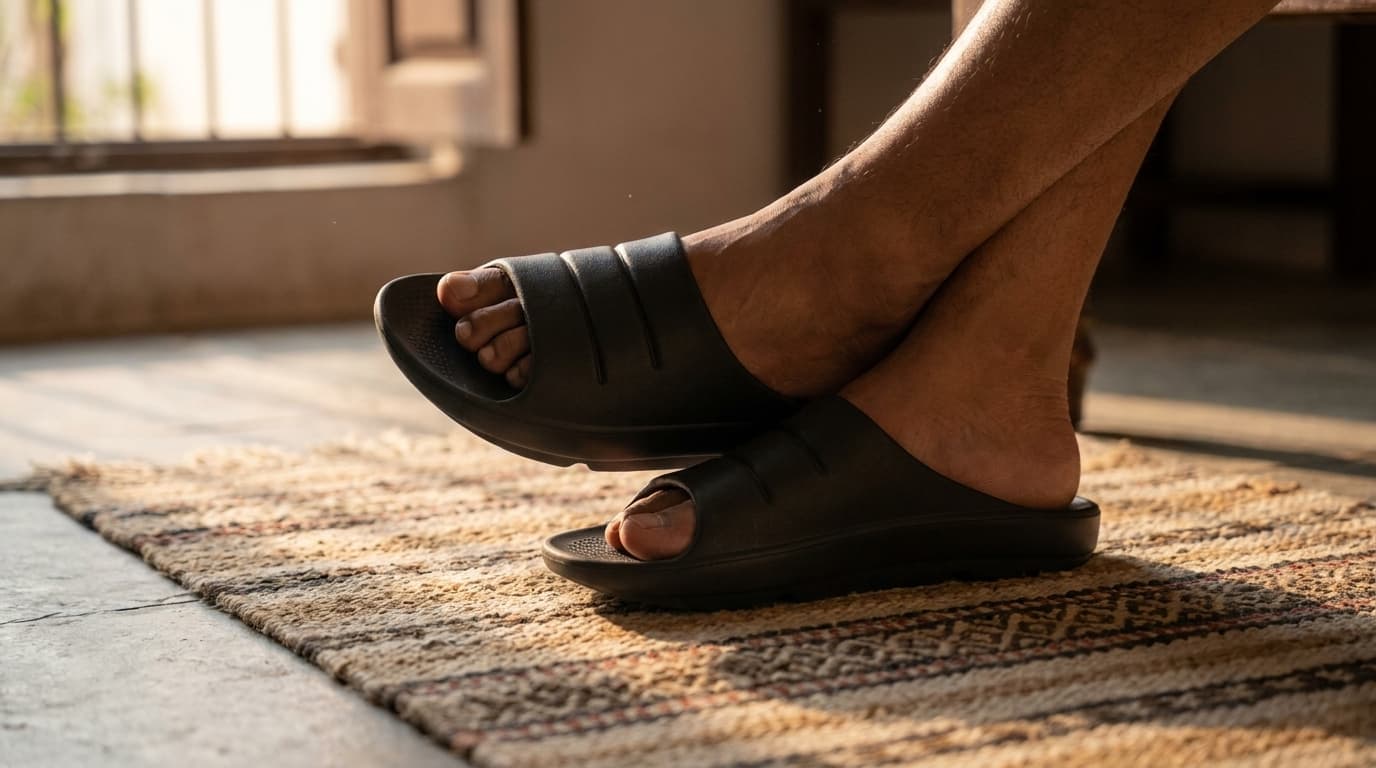
Three parts that decide whether the word is earned
If a pair gets these right, the label is fair. If it gets them wrong, no amount of thickness makes up for it.
- A footbed that is a shape, not a thickness
- Put a flat sole under a foot and the arch spans a gap; whatever the arch is not carrying lands on the heel and the ball of the foot. A contoured footbed fills the gap so the middle of the foot makes contact and the same weight spreads across more sole. Ours is called ArcFit™, and the surface is lightly textured so you feel it move as you walk.
- Foam that springs back rather than packing down
- A sheet of EVA is one continuous material, and continuous material takes a set, hold it compressed for long enough and it stays compressed. CloudFoam™ is expanded into granules first and then fused into the shape of the sole, so you stand on thousands of small pieces instead of one block. Each behaves like its own spring, and the boundaries give the material somewhere to deform into and a route back out.
- A heel cup deep enough to hold the foot in place
- This is the part nobody photographs. A contour only does something if the foot is sitting where the contour is; without a deep cup the heel drifts a few millimetres every step and the arch shape ends up under the wrong part of the foot, which is the same as not having one.
Who should not buy a recovery pair
Anyone who needs protection. This is not safety footwear, no steel toe, no puncture plate, no rating, and it does not become safety footwear because it covers your toes.
Anyone who has been prescribed an orthotic. A moulded footbed and a prescribed device are not alternatives to each other, and dropping an orthotic into a shoe already shaped for a generic arch usually gives you neither.
Anyone whose day is spent outdoors in Indian sun. Our foam is heat-sensitive, and that is a real disqualification rather than a caution, the section below says what happens and why we still chose it.
And anyone hoping footwear will fix pain. See a doctor first and buy shoes second; that order round is the only one that ever works.
How we build ours, including the part that fails
Fanture is designed in Surat, Gujarat and made in China. All 5 styles run the same footbed, the same fused foam and the same outsole across 16 colourways and EU 38–46 unisex, with the prices close together, so what you choose between is coverage and colour rather than how much shoe you can afford.
The limitation is heat. CloudFoam™ can shrink or deform in direct sunlight, in a parked car, against a heater or in hot water, and that damage is not covered by returns. We chose the foam knowing this and would choose it again: the softness that gives way under a heel at the end of a shift is the same softness that gives way on a dashboard, and a compound hard enough to survive the dashboard would do nothing for the floor you actually stand on.
So we optimised for the floor, said so before the buy button rather than after it, and put a care card in the box. Dry indoors, store in shade, rinse cool. Do that and the pair keeps the shape it left the mould in.
Where this guide stops
We cannot tell you how many months a pair lasts. We have not measured it, the answer depends on your weight, your floor and your habits, and any brand quoting you a figure for foam life almost certainly has not measured it either. What we can tell you is what kills one early, which is heat, and that part is not a guess.
CloudFoam™ is heat-sensitive, keep every pair out of direct sunlight and off hot surfaces, and store it in the shade. Sun or heat damage isn't covered by returns.


